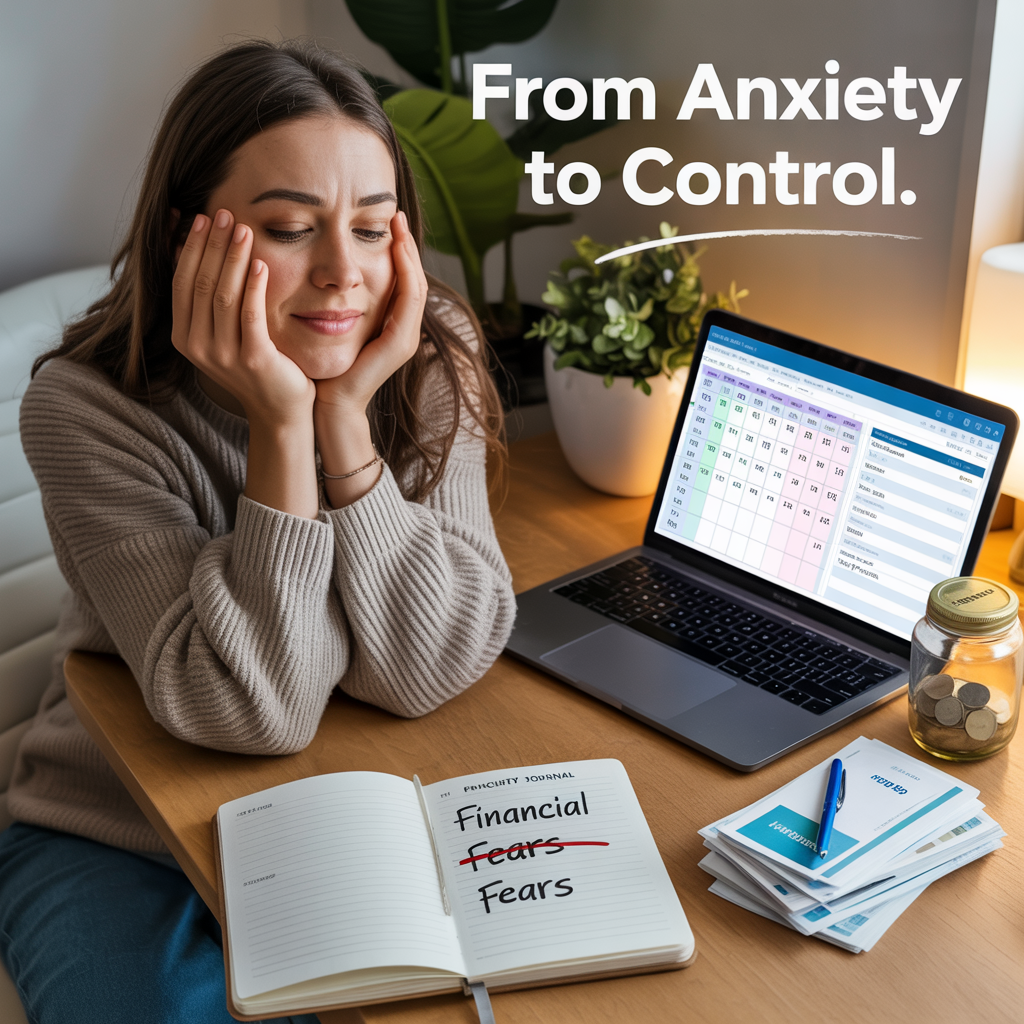
Ever been so stressed about money that you can’t sleep? Three years ago, that was me. Every bill felt like a punch to the gut, and checking my bank account required a deep breath and closed eyes.
Budgeting didn’t just change my finances – it completely transformed my relationship with anxiety. The simple act of tracking where my money goes gave me back control I didn’t know I was missing.
If you’ve been battling financial anxiety like I was, what I’m about to share might be the game-changer you’ve been searching for. Not another lecture about lattes, but practical steps that helped me breathe easier around money.
The crazy part? The solution wasn’t making more money. It was something far simpler that nobody had ever taught me.
My Financial Breaking Point

Signs of Financial Anxiety I Couldn’t Ignore
I missed the warning signs for months. My stomach would clench whenever my phone buzzed with a bank notification. I’d avoid opening bills until the day they were due. Sometimes I’d wake up at 3 AM with my mind racing about money.
Red flags were everywhere. I’d check my account balance 15+ times daily, yet never actually look at what I was spending. I’d make excuses to skip dinners with friends. The “I’ll transfer you money later” text became my signature move.
The worst part? The shame spiral. I was making decent money but had nothing to show for it. I’d swipe my card and feel physically ill, then buy something else to numb that feeling.
The Toll on My Mental Health
The anxiety leaked into everything. I couldn’t focus at work because I was too busy calculating if I could make rent. Sleep? Forget it. My brain had other plans – like replaying every financial mistake I’d ever made.
My relationships suffered. I snapped at my partner when they suggested a weekend trip. I lied to my parents about being “just fine” financially. I isolated myself because pretending everything was okay took too much energy.
Why Traditional Money Advice Wasn’t Working
“Just make a budget and stick to it.” Thanks, I never thought of that!
Traditional advice failed me because:
- Spreadsheets didn’t address my emotional relationship with money
- “Skip the lattes” tips felt insulting when my issues went deeper
- Strict budgets triggered rebellion – I’d follow them for three days, then blow everything on emotional spending
The cookie-cutter plans didn’t account for my irregular income or the reality that I wasn’t just bad with numbers – I was using spending to self-medicate my anxiety.
Discovering the Power of Budgeting

A. My First Budget Attempt
I was drowning in credit card statements and overdraft fees when I finally admitted I needed help. My first budget was a disaster—a hastily scribbled list on the back of a Target receipt that I promptly lost.
Round two? I grabbed a notebook and went all in. I listed every single expense I could think of, then stared at the numbers in horror. The gap between my income and spending was… substantial.
But here’s the thing about facing your financial reality: it hurts at first, then it sets you free. That initial budget was messy and imperfect, but it showed me where my money was actually going (hello, $300 monthly coffee shop habit).
B. Tools That Made Budgeting Accessible
I tried spreadsheets first. They were free but required constant updating, and I’d forget after a few days.
Then I discovered budgeting apps. Game-changer doesn’t even cover it.
| What I Tried | What I Loved | What I Hated |
|---|---|---|
| Mint | Automatic categorization | Too many notifications |
| YNAB | Zero-based method | Learning curve |
| Simple spreadsheet | Complete control | Manual entry |
The right tool feels like it was made for your brain. For me, it was YNAB, despite the learning curve. The mobile app meant I could check my budget before impulse purchases.
C. Shifting from Restriction to Empowerment
Budgeting initially felt like putting myself on a financial diet—all restriction and no joy. I’d beat myself up over every “unnecessary” purchase.
The breakthrough came when I flipped my thinking: a budget isn’t about what you can’t have—it’s a plan for getting what you really want.
I started allocating “fun money” that I could spend without guilt. Even just $50 a month that was truly mine changed everything. My budget became permission to spend, not just rules to follow.
D. Finding My Personal Budgeting Style
We all hear about the 50/30/20 rule or envelope systems, but cookie-cutter approaches rarely stick.
After months of tweaking, I developed my own hybrid style. I’m a visual person, so I use color-coding for different spending categories. I budget weekly instead of monthly because my willpower resets better that way.
Some people need daily check-ins. Others thrive with monthly reviews. Your perfect system is the one you’ll actually use—period.
I also learned to build in breathing room. Those ultra-restrictive budgets where every penny is assigned? They broke me mentally. Now I have a small “buffer” category that prevents the whole system from crashing when life happens.
Creating a System That Stuck

Identifying My True Financial Priorities
I tried budgeting apps, spreadsheets, cash envelopes – you name it. Nothing stuck until I got brutally honest about what actually mattered to me.
The breakthrough? I stopped copying other people’s budget categories and asked myself: “What keeps me up at night? What brings me joy?”
Turns out, I didn’t care about fancy restaurants, but I desperately wanted to visit my sister twice a year. My priorities weren’t what financial gurus said they should be – they were uniquely mine.
So I created just three spending buckets:
- Must-haves (rent, groceries, utilities)
- Peace of mind (emergency fund, retirement)
- Joy fund (travel, hobbies, occasional splurges)
Everything else? I either eliminated it or drastically reduced it. My anxiety plummeted when my spending finally aligned with what truly mattered.
Building Emergency Savings for Peace of Mind
My financial anxiety was mostly fear of the unknown. What if my car breaks down? What if I lose my job?
I started small – just $25 per paycheck into a separate “sleep well at night” account. The first $1,000 took nearly a year, but it felt like a psychological shield going up with every deposit.
When I eventually reached three months of expenses, something incredible happened. I stopped panicking about small financial setbacks. A surprise $400 car repair was annoying, not catastrophic.
The trick was making it automatic and untouchable. I couldn’t see the money in my checking account, so I couldn’t spend it.
The Weekly Check-in Ritual That Changed Everything
Sunday mornings. Coffee. Laptop. Ten minutes.
This simple ritual transformed my relationship with money. I stopped avoiding my finances and started facing them regularly.
I don’t obsess over every penny. I simply:
- Check account balances
- Review last week’s spending
- Preview upcoming bills
- Adjust as needed
The weekly rhythm prevents small problems from becoming disasters. That subscription I forgot about? Caught it before it auto-renewed for a year. Unexpected medical bill? Spotted it before late fees kicked in.
Consistency beats perfection every time. Some weeks I only spend two minutes glancing at my accounts. That’s still enough to stay connected and in control.
Tackling Debt Without Panic

A. My Debt Payoff Strategy
I was drowning in $27,000 of credit card debt when I finally faced reality. The interest was killing me – literally eating up hundreds each month. So I got tactical.
First, I listed every debt with its interest rate. Those 24.99{9b4debaf71539559d24a99dfa2713bda5f3353fb2e9da8a05a5ae6b8140959ed} store cards? Pure evil. Then I ran the numbers two ways: avalanche method (highest interest first) and snowball method (smallest balance first).
The math said avalanche, but my anxiety needed quick wins. So I went snowball. Knocked out a $900 store card in three months and felt like I’d conquered Everest.
I automatically transferred money to a separate “debt destroyer” account on payday before I could touch it. That mental accounting trick? Game-changer.
B. Small Wins That Built Momentum
That first paid-off card gave me a ridiculous high. I cut it up, framed the final statement, and hung it by my desk.
When I eliminated the second card (a $1,200 balance), I added its payment to my attack on the next debt. The snowball grew. My minimum payments stayed the same, but more went to principal each month.
I found unexpected joy in watching those balances drop. I’d check accounts mid-month just to see the numbers shrink. Each $500 milestone got a star on my tracking chart.
My friends thought I was nuts getting excited about paying bills. They weren’t wrong, but they weren’t free either.
C. How I Handled Setbacks
Then my car died. Classic timing.
Instead of automatically reaching for credit cards, I paused my aggressive debt payoff for two months and diverted that cash to an emergency fund. Stretched out repairs over three paydays instead of one big hit.
The old me would have spiraled into “why bother” territory. The new budgeting me understood this was just a detour, not a dead end.
When holiday spending threatened my progress, I got creative. Handmade gifts, secret Santa exchanges instead of buying for everyone, and being honest with family about my goals.
D. Celebrating Milestones
Motivation matters in debt payoff. I created non-spending rewards for hitting targets. At $5,000 paid: a day hike at my favorite spot. At $10,000: finally watching that show everyone was talking about (binge weekend with homemade snacks).
When I crossed the halfway mark, I splurged – $30 on a nice dinner out. Seems small, but it was calculated, budgeted joy, not mindless spending.
Each celebration reinforced that I wasn’t depriving myself – I was choosing freedom. The rush from watching my net worth climb beat any shopping high I’d ever had.
Beyond Numbers: The Emotional Transformation

A. From Money Avoidance to Money Confidence
I used to literally hide my bills under a stack of magazines. Not kidding. Opening bank statements made my heart race so fast I’d feel dizzy.
Money avoidance was my default mode for years. I’d rather do anything—clean the bathroom, organize my sock drawer, watch paint dry—than face my financial reality.
But something unexpected happened when I started budgeting. The anxiety didn’t instantly disappear, but it changed form. Instead of this massive, undefined cloud of doom, my fears became specific, manageable challenges.
The first time I categorized all my expenses and saw actual numbers instead of imagined catastrophes, I breathed deeper than I had in years. Turns out, knowing exactly how broke you are feels way better than the endless spiral of “I’m probably super broke.”
Within three months, I caught myself voluntarily checking my accounts. Six months in, I was forecasting expenses without breaking into a cold sweat.
B. How Budgeting Improved My Relationships
Money tension was poisoning my relationships without me even realizing it.
My partner would suggest dinner out, and I’d snap “We can’t afford it!” without actually knowing if that was true. Friends would invite me on trips, and I’d make up excuses rather than admit I was terrified of spending money.
Budgeting gave me the vocabulary to have honest conversations. Instead of reacting from fear, I could say, “That’s not in my budget this month, but I could make it work next month if we plan ahead.”
The relief on my partner’s face the first time I calmly discussed money without getting defensive was worth every minute I’d spent building my budget.
Even better? I stopped resenting friends with different financial situations because I finally understood my own.
C. The Freedom of Financial Boundaries
The biggest surprise about budgeting wasn’t learning to save—it was learning to spend without guilt.
Before, every purchase felt like a potential mistake. A $4 coffee carried the same emotional weight as a $400 emergency expense. Everything was either “too expensive” or “whatever, I’m already in debt.”
Setting boundaries through budgeting created freedom I never expected. When I decided ahead of time that $50/month could go to completely frivolous things I love, those purchases became guilt-free zones.
Boundaries created clarity. Instead of the constant noise of financial worry, I could make decisions based on my actual priorities.
The emotional payoff was enormous. I stopped waking up at 3 AM panicking about money. I stopped checking my account balance five times a day. I started feeling—dare I say it—in control.

Budgeting transformed my relationship with money from one of constant anxiety to confident control. By creating a sustainable system after reaching my financial breaking point, I was able to face my debt systematically rather than with panic. The most profound change wasn’t just in my bank account, but in my emotional wellbeing—replacing financial fear with peace of mind and clarity about my financial future.
If you’re struggling with financial anxiety, I encourage you to try budgeting not just as a mathematical exercise, but as a tool for emotional transformation. Start small, be consistent, and watch as the simple act of tracking your money brings not only financial stability but also relief from the weight of financial uncertainty. Your journey to financial peace begins with that first budget.